
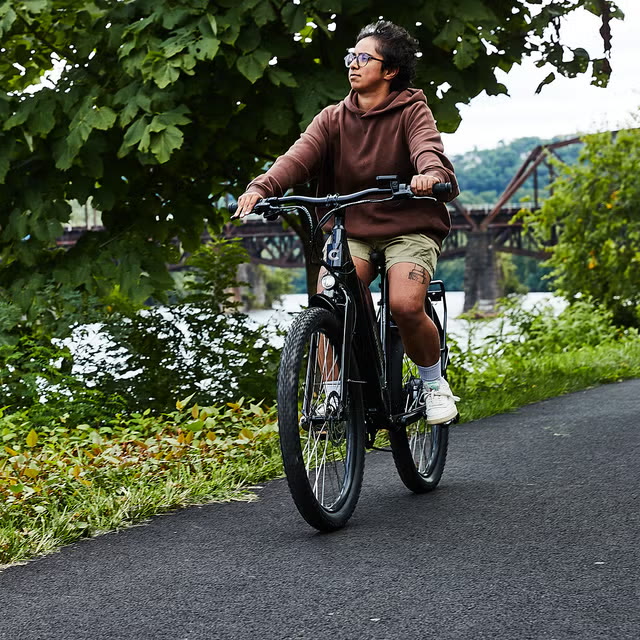
A commuter electric bike is designed to get you from A to B efficiently. It has larger, narrower wheels than a cruiser, a more forward riding position and practical extras such as lights, fenders and a rear rack. On a long paved trail or across a city, it is the quickest and least tiring e-bike to ride.
What is a commuter electric bike?
Commuter e-bikes, often called hybrid or city e-bikes, sit between a road bike and a cruiser:
- 700c or 27.5-inch wheels with tires narrower than a cruiser's, so they roll easily on pavement.
- A moderately upright position, leaning a little forward. You can see traffic and still pedal
efficiently.
- Flat handlebars rather than swept-back cruiser bars.
- Practical equipment: integrated lights, fenders, a rear rack and often a kickstand and bell.
- Gears, usually seven to ten, so you can pedal comfortably at speed.
- A battery integrated into the frame on many models, which keeps them neat and lighter than most
cruisers.
Some commuter e-bikes are Class 3, assisting up to 28 mph. Our e-bike classes guide explains what that means and where Class 3 bikes are and are not allowed.
How a commuter e-bike rides
Commuters feel quick and light compared with cruisers and fat-tire bikes. The bigger wheels hold speed, the narrower tires roll easily and the slightly forward position lets you push on the pedals. Over a 20-mile day on a paved trail, that adds up to much less effort and much more range from the same battery.
The trade-off is comfort at low speed and on rough ground. A commuter does not cushion bumps like a cruiser's balloon tires, and it has no business on sand, where a fat-tire e-bike is the answer.
Who a commuter e-bike suits
- Riders planning long days on Florida's paved rail trails.
- City visitors who want to cover a lot of ground quickly.
- Experienced riders who find cruisers slow and heavy.
- Anyone riding in traffic, where lights and a slightly higher, more alert position help.
Where a commuter e-bike makes sense in Florida
Florida has some excellent long paved trails, and they are commuter country:
- The Pinellas Trail, running from St. Petersburg towards Tarpon Springs.
- The West Orange Trail from Winter Garden, and the
Cross Seminole Trail north of Orlando.
- **City riding in Orlando, St. Petersburg and
Miami,** where distances are longer than in beach towns.
Our best e-bike rides in Florida guide has more routes.
Pros and cons
| Pros | Cons |
|---|---|
| Efficient: more speed and range per charge | Firmer ride than a cruiser |
| Lights, fenders and rack as standard | Forward lean is less relaxed |
| Lighter than most cruisers and fat-tire bikes | Not for sand or rough ground |
| Some are Class 3, up to 28 mph assist | Class 3 is not allowed on every path |
What to ask the shop
- Which class is it? Class 3 is quicker but not allowed on some shared paths.
- Are lights included and charged? You will want them if you ride at dusk.
- What range do riders get on a full day?
- Is there a rack and a lock?
- Can I take it on my route? Some shops limit how far their bikes may go.
Read our rental checklist and the daily vs weekly rates guide if you plan a longer trip.

Frequently asked questions
What is the difference between a commuter and a hybrid e-bike?
Very little. Both terms describe a practical e-bike between a road bike and a cruiser, with flat bars, medium-width tires and gears. Commuter models usually add lights, fenders and a rack as standard.
Is a commuter e-bike faster than a cruiser?
Yes. Larger, narrower wheels and a more efficient position make it quicker and less tiring over long distances. With the same battery, it usually goes further too.
Are Class 3 commuter e-bikes allowed on Florida trails?
It depends on the trail. Local governments and trail managers can restrict e-bikes, and some limit Class
- Our Florida e-bike law guide explains how to check.
Is a commuter e-bike good for the beach?
On paved beach paths it is fine but less relaxed than a cruiser. On sand, no: rent a fat-tire e-bike.